Core Workflows and Functions
engager package
2026-09-14
Source:vignettes/essential-functions.Rmd
essential-functions.RmdOverview
This vignette demonstrates the supported v0.1.0 core using the package’s public API:
- Transcript Processing: Loading and processing Zoom transcripts
- Privacy-Supporting Workflows: Applying structured-field masking and technical review
- Analysis: Core engagement metrics and analysis
- Name Matching: Reviewable exact student name matching workflows
Supported Functions
The package exposes additional interactive guidance helpers, but the functions below define the supported analysis workflow for v0.1.0:
Supported workflow functions ( 21 ):
basic_transcript_analysis()quick_analysis()batch_basic_analysis()load_zoom_transcript()process_zoom_transcript()consolidate_transcript()summarize_transcript_metrics()summarize_transcript_files()analyze_transcripts()plot_users()write_metrics()load_roster()detect_unmatched_names()match_names_workflow()write_unresolved()ensure_privacy()privacy_audit()anonymize_educational_data()validate_privacy_compliance()review_privacy_risks()generate_privacy_review_report()
Core Workflow
1. Load and Process Transcript
# Load a sample transcript
transcript_file <- system.file("extdata/test_transcripts/intro_statistics_week1.vtt",
  package = "engager"
)

# Load the transcript
transcript <- load_zoom_transcript(transcript_file)
cat("Transcript loaded with", nrow(transcript), "comments\n")
#> Transcript loaded with 56 comments
2. Process and Summarize
# Process transcript with privacy defaults
processed <- process_zoom_transcript(
  transcript_df = transcript,
  add_dead_air = TRUE,
  consolidate_comments = TRUE
)

metrics <- summarize_transcript_metrics(
  transcript_df = processed,
  names_exclude = c("dead_air")
)

head(metrics)
#> # A tibble: 4 × 13
#>   transcript_file   name      n duration wordcount comments perc_n perc_duration
#>   <chr>             <chr> <int>    <dbl>     <dbl> <I<list>  <dbl>         <dbl>
#> 1 intro_statistics… Stud…    14      155       361 <chr>      46.7         71.8
#> 2 intro_statistics… Stud…     6       23        48 <chr>      20           10.6
#> 3 intro_statistics… Stud…     5       19        37 <chr>      16.7          8.80
#> 4 intro_statistics… Stud…     5       19        40 <chr>      16.7          8.80
#> # ℹ 5 more variables: perc_wordcount <dbl>, n_perc <dbl>, duration_perc <dbl>,
#> #   wordcount_perc <dbl>, wpm <dbl>
3. Plot and Export
engagement_plot <- plot_users(
  metrics,
  metric = "n",
  facet_by = "none",
  mask_by = "name"
)
print(engagement_plot)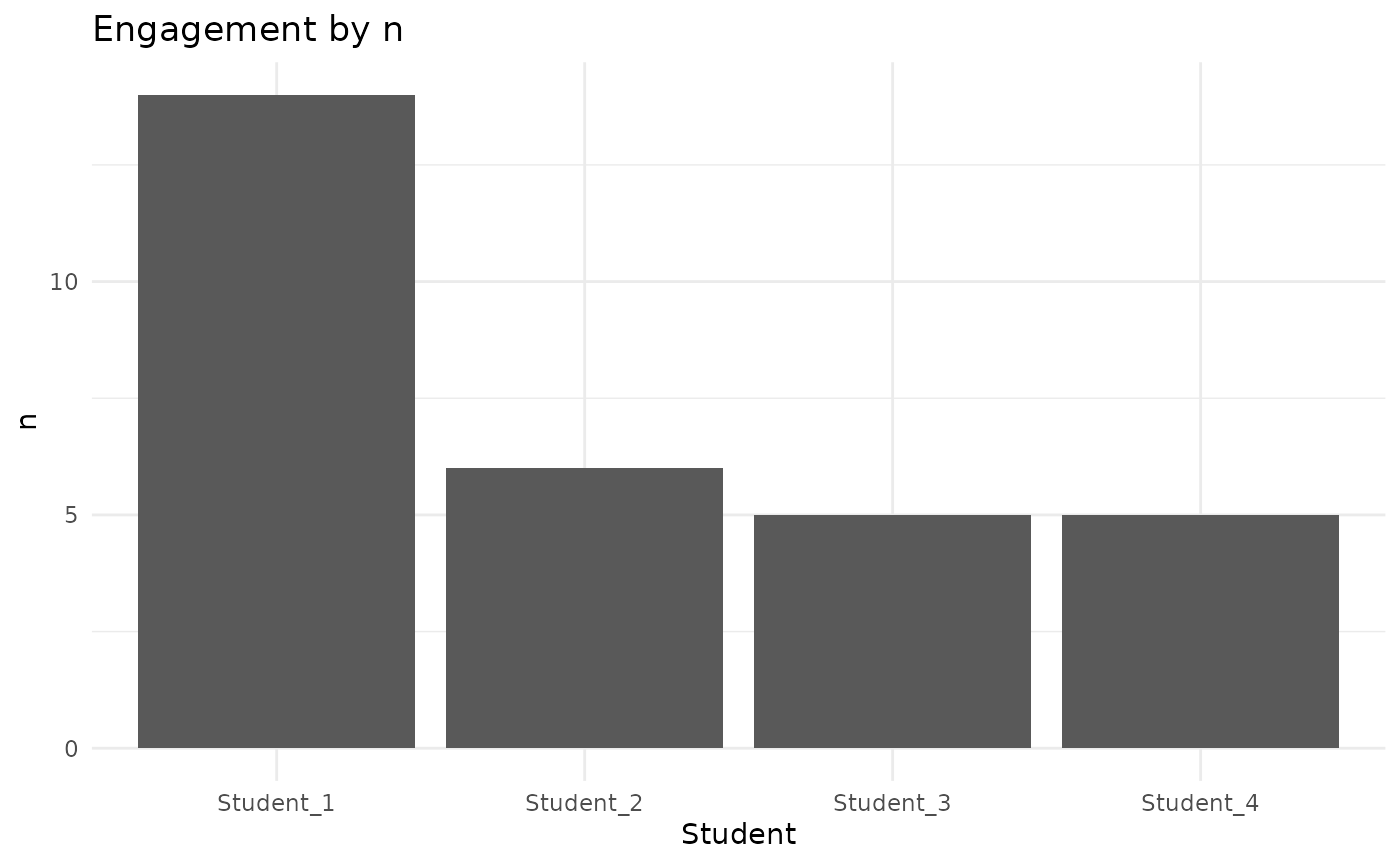
output_file <- tempfile(fileext = ".csv")
write_metrics(
  metrics,
  what = "engagement",
  path = output_file,
  comments_policy = "omit"
)
stopifnot(file.exists(output_file))
unlink(output_file)
4. Run a Privacy Review
# Check privacy risk with synthetic data
synthetic_data <- data.frame(
  name = c("Student A", "Student B", "Instructor"),
  message = c("Hello", "Good morning", "Welcome to class"),
  timestamp = c("00:01:00", "00:02:00", "00:00:30")
)

# Privacy review helpers flag recognized identifier-like columns. They do not
# prove that a data set or free-text field contains no identifying information.
privacy_review <- review_privacy_risks(synthetic_data, audit_log = FALSE)
privacy_review$pii_detected
#> [1] "name"
privacy_review$recommendations
#> [1] "PII detected in columns: name"
#> [2] "Consider using ensure_privacy() to mask identifiable data"
#> [3] "Review institutional privacy policies for data handling"
#> [4] "Ensure data access is limited to authorized personnel"
#> [5] "Use ensure_privacy(..., privacy_level = 'mask') or write_metrics(..., privacy_level = 'mask') for masked outputs"
#> [6] "Implement secure data storage and transmission"
#> [7] "Train personnel on applicable privacy requirements"
#> [8] "Maintain audit trails for data access and modifications"
Function Categories
Transcript Processing
-
load_zoom_transcript()- Load Zoom transcript files -
process_zoom_transcript()- Process and clean transcripts -
consolidate_transcript()- Consolidate consecutive comments -
summarize_transcript_files()- Summarize transcripts at file level
Analysis
-
analyze_transcripts()- Main analysis function -
summarize_transcript_metrics()- Calculate engagement metrics
Privacy Review
-
ensure_privacy()- Mask recognized structured identifier columns -
privacy_audit()- Audit privacy risks -
validate_privacy_compliance()- Review privacy settings
Name Matching
-
load_roster()- Load a roster for matching -
detect_unmatched_names()- Identify speakers requiring review -
match_names_workflow()- Apply the supported exact matching workflow -
write_unresolved()- Write a privacy-supporting unresolved-name review file
Utilities
-
plot_users()- Plot user engagement -
write_metrics()- Export metrics
Supported Boundaries
- Beginner and batch workflows produce per-session metrics, summaries, and plot objects.
- Exact name matching reports unresolved names instead of guessing.
- Output helpers mask recognized structured identifiers and omit raw comment text by default.
- Version 0.1.0 does not generate polished course-level engagement reports or support longitudinal individual-student reporting.
Users remain responsible for reviewing inputs, free text, outputs, sharing decisions, and institutional requirements.